










Difference Between a Delayed, Returned and Refused Saudi Visa Application in 2026
June 5, 2026
Saudi Degree Attestation vs Qualification 2026 Explained
June 6, 2026
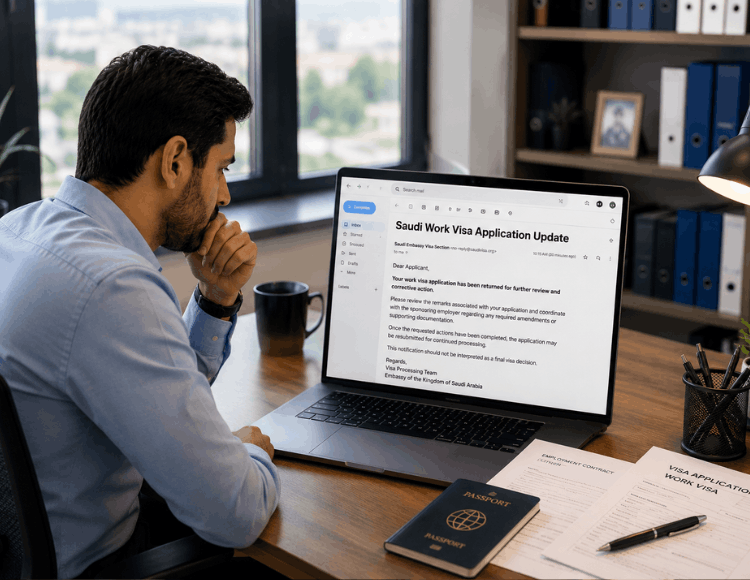
Why Saudi Work Visa Applications Are Returned Before Approval
A returned Saudi work visa application is often one of the most misunderstood outcomes in the immigration process.
For many applicants, the word returned immediately creates uncertainty. Some assume the application has been refused. Others believe it has entered a lengthy review cycle or become stuck within the system.
In reality, a returned application represents something entirely different.
It is neither an approval nor a refusal. It is not necessarily a delay, and it should not automatically be viewed as a negative outcome.
More commonly, a returned application indicates that additional action, clarification, or correction may be required before the review process can continue effectively.
For employers, HR teams, mobility professionals, and international hires, understanding why applications are returned can help reduce disruption, improve filing quality, and support more predictable workforce mobilisation outcomes.
As Saudi Arabia continues strengthening workforce administration and immigration processes, application readiness is becoming an increasingly important part of successful visa filing.
What Does a Returned Saudi Work Visa Application Mean?
A returned application typically indicates that a submission cannot currently progress in its existing form.
Rather than reaching a final decision, the application is redirected for amendment, clarification, correction, or supporting action before assessment can continue.
This distinction is important.
A returned application does not automatically indicate that the applicant is ineligible for a visa. Nor does it necessarily suggest a serious compliance issue.
Instead, the return often reflects the need for greater consistency, accuracy, alignment, or supporting information before review can move forward.
In many situations, the issue is administrative or procedural rather than substantive.
Why Returned Applications Are Different From Delays
Delays and returns are frequently confused, yet they represent different stages of the process.
A delayed application generally remains within the review pathway and requires additional time before a decision can be reached.
A returned application interrupts that progression.
The reviewing authority has identified an issue that requires attention before the case can continue through assessment.
The distinction is significant.
A delay primarily involves waiting.
A return generally requires action.
Understanding this difference helps employers and applicants respond appropriately rather than assuming additional time alone will resolve the issue.
Why Returned Applications Are Different From Refusals
A refusal represents a final outcome.
A returned application does not.
Where a refusal brings the application pathway to an end, a return typically creates an opportunity to address the identified issue before review continues.
For organisations managing onboarding schedules and workforce deployment plans, this distinction matters.
Treating a returned application as a refusal can create unnecessary concern and disrupt planning activities unnecessarily.
The two outcomes serve very different functions within the wider immigration process.
Why Returned Applications Are Different From Pending Review
Pending review indicates that assessment activity remains ongoing.
The application continues moving through the review process while a decision is being considered.
A returned application indicates that progression has paused because additional action is required before meaningful review can continue.
One status reflects continued assessment.
The other reflects the need for intervention.
Understanding the difference allows employers and applicants to take more informed action when reviewing application updates.
Common Reasons Applications May Be Returned
One of the most overlooked aspects of returned applications is the role of employer-side information.
Many applicants assume that returned cases always relate directly to their own documentation.
In practice, work visa applications operate within a broader workforce administration environment.
Organisational records, workforce data, position allocations, compliance information, and supporting employer documentation can all influence the filing ecosystem.
Where inconsistencies emerge within that wider environment, additional action may be required before review can continue.
This is one reason successful immigration outcomes increasingly depend on organisational readiness as much as applicant readiness.
Why Employer Records Can Influence Application Outcomes
One of the most overlooked aspects of returned applications is the role of employer-side information.
Many applicants assume that returned cases always relate directly to their own documentation.
In practice, work visa applications operate within a broader workforce administration environment.
Organisational records, workforce data, position allocations, compliance information, and supporting employer documentation can all influence the filing ecosystem.
Where inconsistencies emerge within that wider environment, additional action may be required before review can continue.
This is one reason successful immigration outcomes increasingly depend on organisational readiness as much as applicant readiness.
The Operational Impact Often Extends Beyond the Application
The most significant consequence of a returned application is rarely the application itself.
The wider impact often affects workforce planning activities that depend upon predictable mobilisation timelines.
Returned applications can influence:
- Employee onboarding schedules
- Relocation planning
- Project deployment timelines
- Recruitment commitments
- Workforce mobilisation activities
- Internal resource allocation
Even relatively minor administrative interruptions can create broader operational consequences where hiring plans are built around expected deployment dates.
For this reason, many organisations increasingly focus on filing quality before submission rather than troubleshooting issues after they emerge.
Why Early Document Review Is Becoming More Valuable
Many returned applications can be linked to issues that could potentially have been identified before submission.
As workforce administration becomes increasingly digital, documentation accuracy and information consistency are receiving greater scrutiny throughout the filing process.
Early document review helps identify potential weaknesses before they become filing obstacles.
Rather than reacting to returned applications after they occur, employers are increasingly adopting preventative approaches focused on preparation, verification, and submission quality.
This reflects a broader shift towards proactive workforce governance rather than reactive case management.
Why Employer Coordination Remains Critical
Work visa applications often involve contributions from multiple stakeholders.
HR teams, recruiters, mobility specialists, legal advisers, compliance personnel, and external providers may all contribute information that ultimately forms part of the filing process.
Where communication gaps emerge, inconsistencies can follow.
Strong employer coordination helps maintain alignment across documentation, workforce planning, and immigration activity.
The result is often a smoother filing experience and a reduced likelihood of avoidable administrative returns.
Executive Insight
Returned Applications Are Increasingly Becoming Quality-Control Checkpoints
As workforce administration becomes more digitally connected, returned applications are increasingly viewed by many organisations as indicators of filing quality rather than indicators of final visa viability.
For employers, a returned application can provide valuable operational feedback regarding documentation readiness, information consistency, and administrative alignment before a final immigration outcome is reached.
Organisations that treat returned applications as quality-control checkpoints often identify underlying issues more quickly than those that view them solely as immigration setbacks.
This reflects a wider trend across workforce mobility, where preparation quality is becoming just as important as application submission itself.
Returned Applications Are Usually a Process Signal, Not a Final Outcome
One of the most important principles for employers and applicants to remember is that a returned application should not automatically be interpreted as a negative result.
In many situations, it is simply a process signal.
The review pathway has identified an issue that requires attention before assessment can continue effectively.
Understanding that distinction helps organisations allocate resources more efficiently, maintain realistic expectations, and respond appropriately when returns occur.
The Strategic Shift Organisations Are Making
As Saudi Arabia’s workforce ecosystem becomes increasingly integrated, successful immigration outcomes are becoming more closely linked to preparation quality than submission activity alone.
Organisations that prioritise document readiness, filing accuracy, employer coordination, and administrative consistency are often better positioned to minimise disruption and maintain momentum throughout workforce mobilisation projects.
The question is no longer simply whether an application has been submitted.
Increasingly, the more important question is whether the application was prepared to withstand review before entering the system.
Supporting Successful Saudi Work Visa Filings
Saudi & Gulf Visa Services supports employers and professionals with Saudi work visa filing support, document review, employer coordination, application preparation, and immigration advisory services across Saudi Arabia and the wider GCC region.